In immersive projection setups, multiple projectors work together to cover large or multi-surface areas. However, where projector images overlap at the edges, visible artifacts such as bright lines, dark bands, ghosting, or mismatched brightness can appear. These issues severely disrupt visual continuity and destroy the sense of immersion.
Edge Blending is the essential technology that solves this problem. It precisely adjusts brightness gradients (blending) and corrects geometric distortion (warping) in the overlap zones, allowing multiple projectors to create a single, seamless, uniform large-scale image.
Whether for three-wall CAVE systems, curved panoramic screens, or full 360° surround environments, high-quality edge blending is what turns “multiple projectors” into “one continuous immersive canvas.”
Why Edge Blending Is Indispensable in Immersive Projection
- Seamless Transitions: Automatically gradients brightness in overlap areas to eliminate double-brightness or visible seams.
- Geometric Correction: Compensates for distortions caused by irregular walls, curved surfaces, angled installations, or non-flat projection areas.
- Uniform Brightness: Ensures consistent luminance across the entire projected surface — no brighter center or darker edges.
- Scalability: Easily supports 3, 4, 6, 8, or more projectors in complex multi-channel setups.
Without reliable edge blending, even the most expensive projectors cannot deliver a convincing immersive experience.
Software-Based vs Hardware-Based Edge Blending: Why We Strongly Recommend Hardware
There are two primary approaches to edge blending on the market today: software-based (running on a PC or server) and hardware-based (dedicated standalone devices).
| Comparison Item | Software-Based (PC + Software) | Hardware-Based (Geobox) |
| System Stability | Dependent on host PC and software; prone to crashes, driver conflicts, or OS updates | Fully independent hardware; extremely reliable and stable |
| Failure Recovery | If the host PC fails or software crashes, entire blending is lost | Host PC can be replaced or bypassed (switch to another HDMI source); pre-set blending remains intact |
| Re-Setup Effort | Requires full re-installation, re-calibration of all parameters — very time-consuming | One-time setup is permanently stored; no re-adjustment needed even after source change |
| Input Source Flexibility | Limited by PC graphics card resolution and compatibility | Supports virtually any HDMI / DP / VGA source, no resolution restrictions |
| Maintenance | Requires ongoing software updates, driver management, and specialist support | Plug-and-play; minimal maintenance |
| Suitability for 24/7 Use | Not ideal for continuous or mission-critical operation | Designed |
Why Geobox? The True “Best Partner” for Immersive Projection
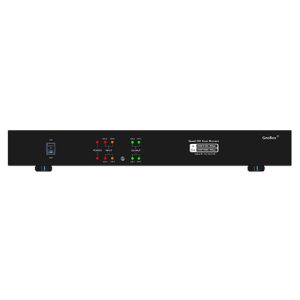
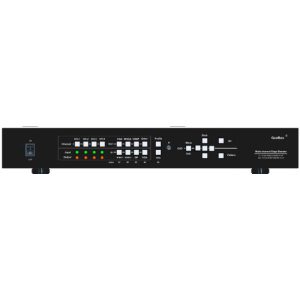
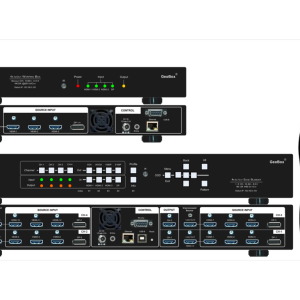
Geobox is a global leader in professional-grade hardware edge-blending processors (popular models include the M810 and G814 series). Its key strengths directly address the pain points of immersive projection:
- True Hardware Independence: All blending, warping, masking, and black-level uplift parameters are stored inside the device itself. No dependency on external PCs — if the playback computer fails, is replaced, or switched to a different source, the blending configuration remains 100% unaffected.
- Exceptional Long-Term Reliability: Engineered for 24/7 continuous operation with very low failure rates, ideal for educational institutions, public exhibitions, and therapeutic spaces.
- Powerful Capabilities:
- Multi-channel output (single unit handles 2–4 projectors; cascade for larger setups)
- Support for 4K input/output, curved surface correction, non-standard resolutions
- User-Friendly Operation: Adjustable via IR remote, web interface, USB, or Ethernet; one-time setup is saved permanently.
- High Scalability: Multiple units can be cascaded to support 8+ projectors in large-scale immersive environments.
Perfect Fit for Different Immersive Scenarios
- Immersive CAVE (Three Walls + Floor): Handles multi-surface overlaps and floor projection with zero visible seams at corners or transitions — currently the most stable solution for true CAVE systems.
- VR 360 Curve Screen (Panoramic Curved Display): Precise warping ensures seamless blending on 150°–360° curves, delivering flawless 360° content playback.
- Multi-Purpose Classrooms / Interactive Rooms: Stores multiple presets (e.g., “immersive mode” vs “standard projection mode”) for instant switching when using sliding partitions.
Museums / Brand Experience Centers: Rock-solid performance for long-duration exhibitions with zero daily re-calibration required.