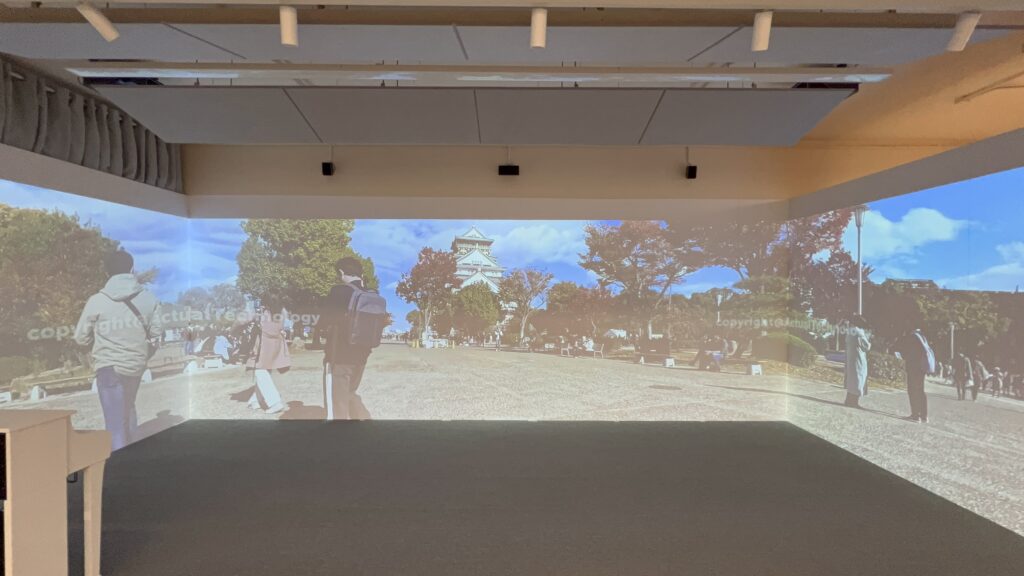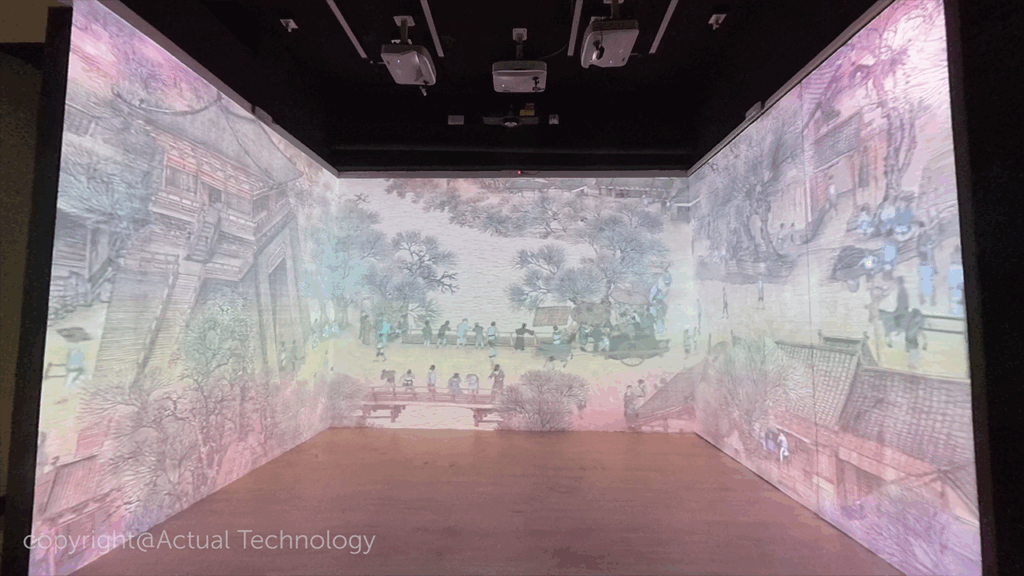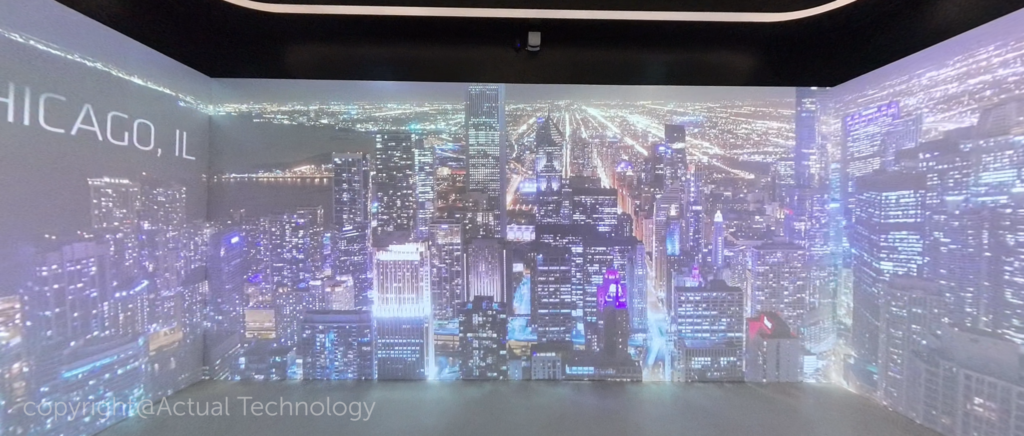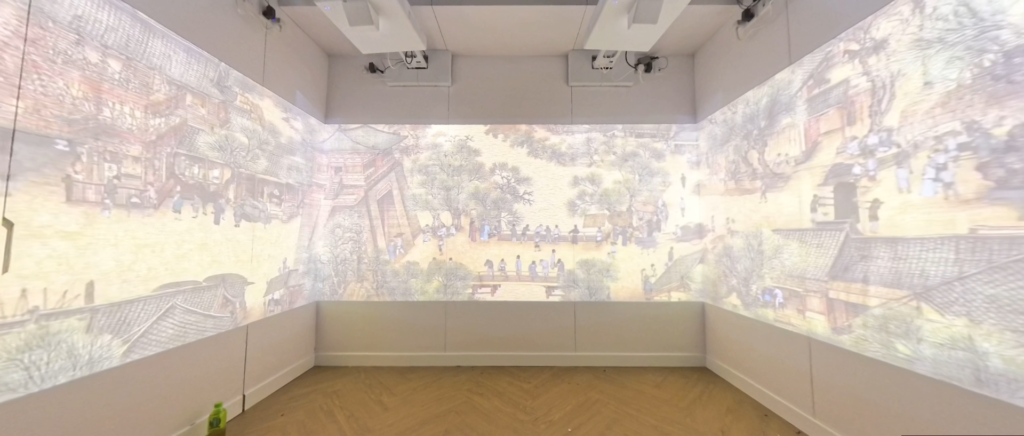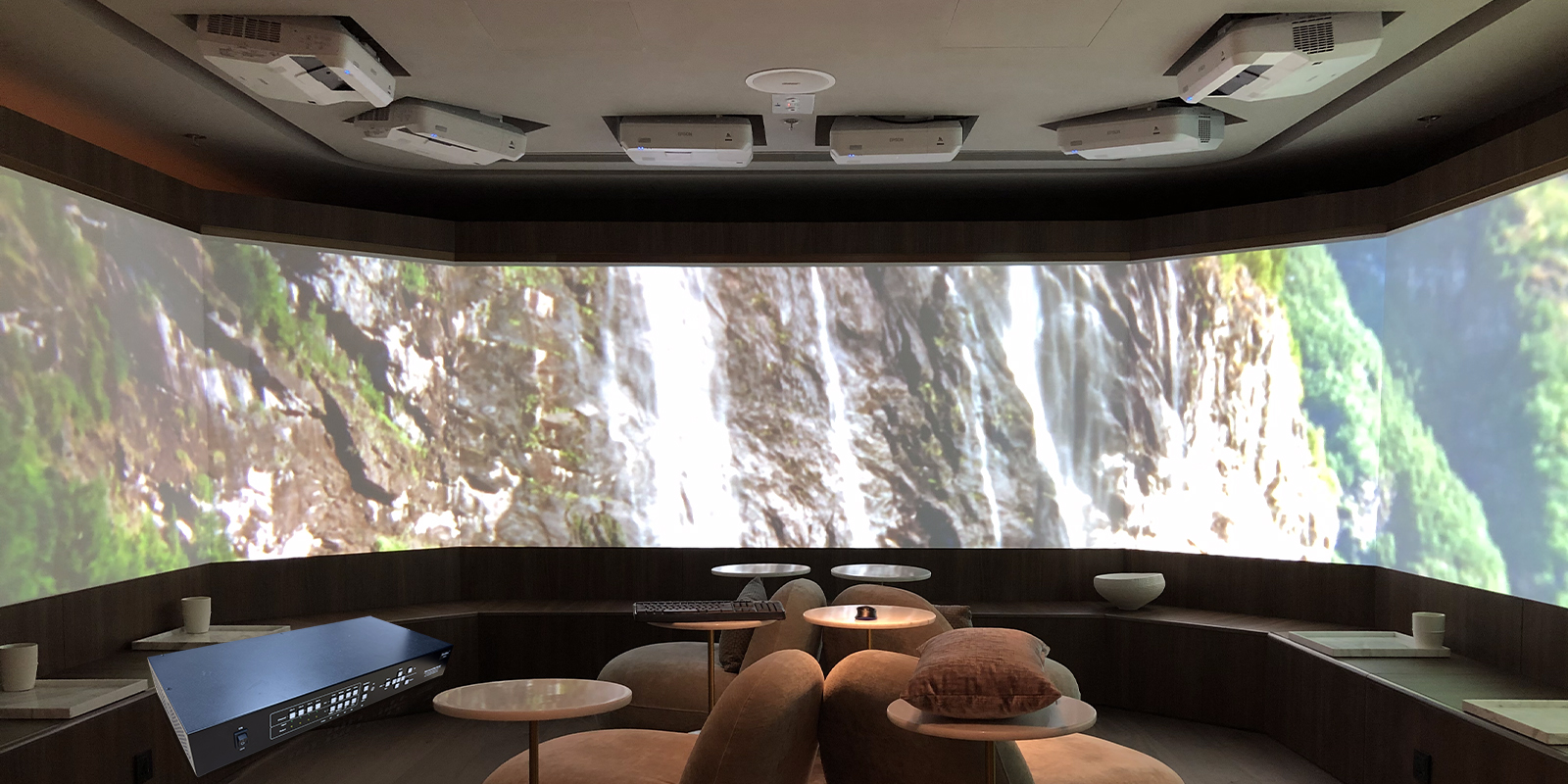
The Immersive CAVE (Cave Automatic Virtual Environment) is the most established and versatile form of immersive projection. It transforms an ordinary room into a near-enclosed “virtual cave” by projecting synchronized content onto multiple surfaces — most commonly three walls plus the floor, with some advanced setups including the ceiling.
Typical Configuration:
- Projection surfaces: Three vertical walls (optional floor for full enclosure)
- Projectors: Usually 3–8 ultra-short-throw (UST) models (e.g., 0.25x–0.47x throw ratio lenses) mounted close to surfaces (30–80 cm distance) to minimize shadows and maximize coverage
- Processing: Edge-blending and geometry correction processors (e.g., Geobox series) ensure seamless image continuity across corners and surfaces
- Optional enhancements: Sliding or retractable partition doors to dynamically form the enclosed space when needed
Key Advantages:
- Excellent Space Adaptability: Works effectively in existing classrooms, therapy rooms, multi-function halls, or even vacant offices with minimal structural modification.
- High Functional Flexibility: Movable partitions allow quick switching between immersive mode (enclosed cave) and standard room use (e.g., conventional classroom, meeting, or event space).
- Natural Multi-User Interaction: No headsets required — participants can move freely, collaborate, gesture, or physically engage with floor content, supporting group activities and natural body movement.
- Strong Spatial Presence: Simultaneous wall + floor projection creates a convincing “inside the scene” feeling, especially powerful for vertical and ground-level content.
Common Real-World Applications:
- Education: Students “enter” historical battlefields, explore inside the human body, simulate chemical reactions in 3D, or walk through ecosystems.
- Rehabilitation & Therapy: Sensory integration training, attention/focus exercises, calming environments for autism spectrum support, elderly cognitive stimulation, or stress reduction.
- Corporate & Professional Training: Safety drills, emergency response simulations, product scenario walkthroughs, team-building immersive storytelling.
- Museums & Cultural Centers: Smaller-scale immersive storytelling rooms for group experiences.
Advantages Over LED Walls or Video Walls
Immersive projection offers distinct benefits in many scenarios:
- Envelopment & Immersion: Covers multiple surfaces (walls + floor), providing true 360-degree surround experience. LED/video walls are usually limited to flat, single-plane displays.
- Surface Flexibility: Projects effectively on flat, curved, irregular, or even non-planar surfaces. LED panels require precise flat alignment and are less adaptable to complex geometries.
- Cost-Effectiveness for Large Areas: In bigger installations, the cost of projectors and setup is often more favorable than equivalent LED resolution and coverage.
- Creative Freedom: Supports advanced projection mapping and multi-surface content blending, enabling highly imaginative and site-specific visuals.